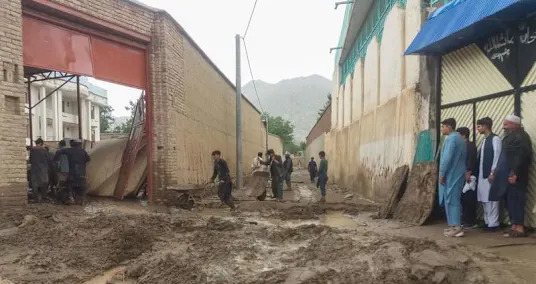
At least 61 people have been killed and 116 injured across Afghanistan since March 26 due to heavy rainfall, floods, landslides and lightning strikes, the Afghan government said on Saturday.
At least four people were still missing after floods affected thousands of families and damaged 2,448 houses, Afghan government spokesman Zabihullah Mujahid said in a post on X.
In addition, thousands of hectares of cropland was also destroyed, posing serious risks to rural communities who rely on agriculture for their livelihoods.
Deadly flooding has struck Afghanistan repeatedly in recent years, causing significant loss of life, injuries and widespread damage to homes, infrastructure and agricultural land.
Extreme weather events such as flash floods and droughts are increasing in Afghanistan, which experts link to the climate crisis.
Despite having a negligible carbon footprint, the country ranks among the most climate-affected nations and remains ill-prepared to cope after decades of conflict, poor infrastructure and a struggling economy, compounded by recent earthquakes and severe flooding.
LATEST POSTS
- 1
 NASA’s Artemis II mission will take an astronaut crew around the Moon – a space policy expert describes the long road to launch
 - 2Huge rotating structure of galaxies and dark matter is detected
- 3Have gravitational waves provided the first hint of primordial black holes born during the Big Bang?
- 4How on earth did 'Shark Tank' star Kevin O'Leary end up in 'Marty Supreme'? I'll let him explain.
- 5She's been a Bond girl and a mutant. Now she's grappling with Hollywood's obsession with 'eternal youth.'


- Lecturer who called Israel a terrorist state to remain Plaid Cymru candidate
- Lilly becomes first healthcare firm to join trillion-dollar club, Wall Street reacts
- Russian drone slams into block of flats in deadly wave of strikes across Kyiv
- Minneapolis ICE shooting live updates: Protests continue over agent's killing of Renee Nicole Good; Walz puts National Guard on standby
- Reviving Your Home with Nutritious Indoor Plants
- Italy Brings In New Measures In 2026 To Tackle Overtourism
- Equality requires universal draft, participation in economy and workforce, MK Liberman says
- European Travel Objections for 2024
- 7 Extraordinary Efficiency Applications for Experts